AI Reframing: Turn Negative Thoughts into Calm Action

Using AI to Turn Negative Thoughts Around: A Practical Guide for Mindset, Confidence, and Daily Self-Growth
Negative thoughts can feel automatic, convincing, and exhausting—especially when they repeat during stress, social situations, or decision-making. AI can be used as a private, structured thinking partner to slow the spiral, identify distorted patterns, and generate balanced alternatives that still feel believable. This guide lays out a practical, repeatable way to reframe thoughts using AI while keeping personal boundaries, emotional realism, and daily consistency in focus.
What “turning negative thoughts around” actually means
Turning negative thoughts around isn’t about forcing cheerfulness or pretending everything is fine. It’s the skill of moving from absolute, harsh conclusions to accurate, workable interpretations that help you regulate emotions and choose better next actions.
- Reframing is not “positive thinking.” It’s a shift from extremes to accuracy and usefulness.
- The goal is emotional regulation and better behavior—not winning an argument against your feelings.
- Common triggers include ambiguity, rejection sensitivity, perfectionism, fatigue, and high-stakes outcomes.
- Helpful outcomes to track: lower intensity, more self-compassionate language, clearer next steps, and quicker recovery after setbacks.
This is closely related to cognitive restructuring, a core CBT skill used to evaluate and update unhelpful thought patterns (see the APA definition of cognitive restructuring).
Where AI fits in a healthy mindset routine
AI works best as a structure tool: it helps you name the thought, label the pattern, generate alternatives, and plan a small action. Think of it as a coach-like mirror—useful for clarity—rather than a judge, fortune teller, or a replacement for professional mental health support.
- Ideal moments: after a difficult email, before a conversation, during rumination, or when confidence dips before work, fitness, or social goals.
- Set a time limit (about 5–12 minutes) so it supports your life rather than becoming another avoidance loop.
- If thoughts are tied to severe distress, trauma, self-harm, or safety concerns, seek qualified help promptly. For an overview of evidence-based approaches, see NIMH guidance on psychotherapies and the NHS overview of CBT.
A 6-step AI reframing loop (fast, repeatable, and realistic)
Use this loop when a thought feels sticky, harsh, or urgent. The goal is not to erase emotion, but to reduce distortion and regain choice.
Step 1 — Capture
Write the thought exactly as it appears—no edits. Example: “I’m going to mess this up and look stupid.”
Step 2 — Context
Add what happened, what it means to you, and what you fear it implies. Example: “I’m presenting tomorrow. If I stumble, it means I’m not cut out for this role.”
Step 3 — Feeling + intensity
Name the emotion and rate it 0–10. This gives you a baseline and makes progress measurable.
Step 4 — Pattern check
Ask AI to identify distortions such as all-or-nothing thinking, catastrophizing, mind-reading, overgeneralizing, or labeling. This step creates distance: it’s easier to work with “a pattern” than “the truth.”
Step 5 — Balanced alternatives (3 styles)
Generate three reframes that you can actually believe:
- Evidence-based: grounded in known facts and past data.
- Compassionate: how you’d talk to a friend in the same situation.
- Action-oriented: a realistic focus that points to the next move.
Step 6 — Micro-action
Thought patterns and practical reframes (examples you can reuse)
| Pattern | Example Thought | Balanced Reframe | 5-Minute Next Step |
|---|---|---|---|
| All-or-nothing | If I can’t do it perfectly, it’s pointless. | Doing it imperfectly still builds skill and momentum. | Set a 5-minute timer and start the first rough draft. |
| Catastrophizing | This mistake will ruin everything. | This is a setback with specific consequences, not a total collapse. | List the most likely outcome and one repair action. |
| Mind-reading | They think I’m incompetent. | There isn’t enough evidence to know what they think; clarification is possible. | Draft a short clarification question or request feedback. |
| Overgeneralizing | I always mess things up. | There are some areas that need work, and there are also examples of progress. | Write two counterexamples from the past month. |
| Labeling | I’m just not confident. | Confidence varies by context and can be trained through small exposures. | Choose one small exposure and do it once today. |
Daily confidence practice: a 10-minute routine
Boundaries, privacy, and emotional safety when using AI
A practical digital guide to keep the process consistent
Recommended picks
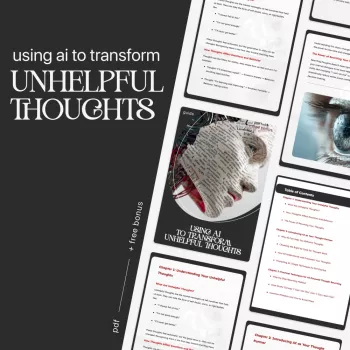
- Using AI to Turn Negative Thoughts Around – Practical Digital Guide on how to use ai to reframe negative thoughts for Mindset, Confidence & Daily Self-Growth ($7.99): a structured, low-friction way to practice reframing consistently, with a focus on mindset, confidence, and everyday self-growth habits.
- Unlocking Savings Secrets — Master Your Deal Hunting Routine ($8.99): useful if your negative thoughts spike around money decisions—turn “I’m terrible with money” into a scheduled, repeatable routine that builds calm through clear steps.
FAQ
Can AI really help with negative thoughts, or does it just distract from them?
AI can help when it’s used briefly and intentionally to structure reframing: naming the thought, spotting patterns, generating balanced alternatives, and choosing a small action. It works best as support for real-world behavior change, not as a substitute for therapy or deeper care.
What should be shared with AI when reframing thoughts?
Share only what’s necessary: the thought, a bit of context, your emotion/intensity, and any relevant facts. Avoid personal identifiers by using placeholders, and seek qualified support for crisis-level situations or safety concerns.
How often should reframing be practiced to build confidence?
A short daily routine (about 5–10 minutes) is usually enough to build momentum. Work on one recurring thought loop for a week, track intensity ratings, and pair reframes with micro-actions to create evidence that you can handle challenges.











Leave a comment