Cordless Pole Saw vs Battery Tree Trimmer: Yard Pick
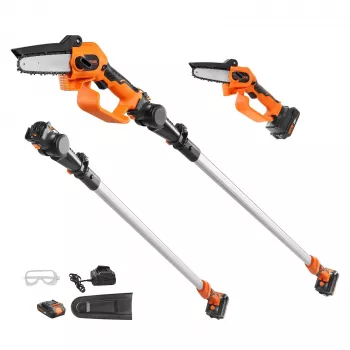
Cordless Pole Saw Chainsaw vs Battery Powered Tree Trimmer: What Works Best for Your Yard
Choosing between a cordless pole saw chainsaw and a battery powered tree trimmer comes down to reach, cut capacity, control, and how often branches need pruning. Both are convenient alternatives to gas tools, but they shine in different tasks—especially when working overhead, cleaning up storm debris, or maintaining small trees and shrubs.
Quick differences at a glance
A cordless pole saw chainsaw is built for overhead cutting: it puts a small chainsaw head on the end of an extended pole so you can limb trees from the ground. A battery powered tree trimmer typically refers to a compact, handheld tool for closer-range pruning—great for shaping shrubs, cleaning up small limbs, and doing fast touch-ups where precision matters.
The biggest decision factors are maximum branch diameter, working height, weight and fatigue during use, and how cleanly you can cut when branches are tucked into dense growth or near fences.
| Feature | Cordless Pole Saw Chainsaw | Battery Powered Tree Trimmer |
|---|---|---|
| Best use | High branches, limb removal, canopy maintenance | Shrubs, small branches, close-range pruning |
| Reach | Extended (pole length adds overhead access) | Short (handheld range) |
| Cut capacity | Typically larger branch diameters | Typically smaller branch diameters |
| Control in tight spaces | Harder overhead; pole can be unwieldy near fences/hedges | Easier to maneuver around dense growth |
| Fatigue | Higher due to leverage and overhead work | Lower for short sessions; can be repetitive for lots of branches |
| Safety considerations | Overhead cutting risks; requires strong stance and clear drop zone | Closer cutting; eye/hand protection still essential |
When a cordless pole saw chainsaw is the better pick
If your yard has trees that routinely drop deadwood, brush the roofline, or shade walkways, the pole saw style usually wins because it solves the “too high to reach” problem without dragging out a ladder.
- Overhead access: Ideal for pruning limbs that are out of reach from the ground without a ladder, especially around driveways, patios, and fences.
- Limbing and storm cleanup: Handles branches that would be slow to tackle with smaller trimming tools, particularly when you’re making repeated cuts on medium limbs.
- Canopy shaping: Useful for removing deadwood and thinning small-to-medium limbs to improve clearance and airflow.
- Cleaner workflow: Fewer tool changes when multiple elevated cuts are needed across the yard; you can reposition and keep moving.
When a battery powered tree trimmer is the better pick
For landscaping-focused maintenance—shrubs, ornamental trees, and tight garden spaces—a compact trimmer is often the easier, cleaner choice. You’re closer to the cut, you can see the branch collar more clearly, and you can avoid bumping surrounding stems with a long pole.
- Detail work: Better for shaping shrubs, small fruit trees, and tight areas where a long pole would snag.
- Quick maintenance: Convenient for short trimming sessions and frequent touch-ups when you notice a few problem branches.
- Lower weight and faster setup: Typically easier to store, carry, and start for small tasks—especially if you’re stepping out for just 10–15 minutes.
- Greater precision near structures: Helpful around fences, garden beds, and decorative landscaping where you need controlled, targeted cuts.
Power, battery, and runtime: what actually matters
Battery yard tools are often marketed by voltage, but real-world cutting performance depends on the whole system: motor design, chain condition, and how hard and dry the wood is.
Cut quality and plant health
For homeowner-friendly pruning guidance, see the International Society of Arboriculture’s consumer resources at TreesAreGood.org and the University of California Agriculture and Natural Resources guide on pruning landscape trees.
Safety and handling: overhead work changes the rules
For more on hazards and safe work practices, review OSHA’s guidance on tree care operations.
A practical hybrid option: a 2-in-1 setup for both reach and close cuts
Featured product
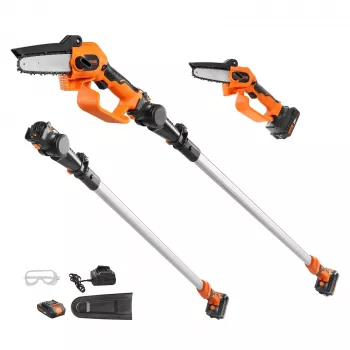
2-in-1 Cordless Pole Saw & Mini Chainsaw – 20V Battery Powered Tree Trimmer (In stock, $149.01) is designed to cover overhead pruning and close-range branch cutting in one setup.
Maintenance basics that keep either tool cutting well
Shop smart add-ons
If you like planning purchases around seasonal sales (extra batteries, replacement chains, protective gear), a deal-planning guide can help you time upgrades without rushing. Unlocking Savings Secrets — Master Your Deal Hunting Routine is a quick digital guide for building a repeatable “check-and-buy” routine.
FAQ
What size branches can a cordless pole saw chainsaw cut?
Cut capacity varies by model and wood hardness, so check the manufacturer’s rated maximum diameter and don’t force the saw through thicker limbs. For large branches overhead—or anything that could fall unpredictably—consider hiring a professional.
Is a battery powered tree trimmer strong enough for tree limbs?
It’s usually strong enough for small limbs and shaping work, especially when the blade or chain is sharp and you use steady, controlled pressure. For larger limbs, a pole saw or mini chainsaw is typically faster, cleaner, and less stressful on the tool.
Is it safe to use a pole saw from a ladder?
It’s best to avoid ladders because balance changes quickly when the saw binds or a branch shifts, increasing the risk of a fall. Use ground-based reach with stable footing and proper protective gear, and call an arborist for difficult cuts.









Leave a comment